Do you want to deepen your understanding of how the universe
works, as well as develop invaluable problem-solving skills?
A Level Physics will allow you to study the world around you at every scale, from the smallest particles to galaxies remote in space and time.
The theoretical topics are always linked to practical applications, with practical skills incorporated throughout the course.
The first year of the course mainly builds on topics you will have studied at GCSE, while most of the second-year topics are new and will not have been covered previously.
What will my day look like?
Explore example timetableCourse Information
At least five GCSEs at grades 9-4 in one sitting. An average GCSE score of 5 or more is preferred.
GCSE English and Maths at grade 4.
There are three written examinations that are taken at the end of the two-year course, together with a Practical Endorsement assessed throughout the course. Paper 1 (Modelling Physics) is worth 37%, Paper 2 (Exploring Physics) is worth 37%, and Paper 3 (Unified Physics) is worth 26%.
- Development of Practical Skills in Physics
- Experimental Design and Data Analysis
- Foundations in Physics
- Physical Quantities and Units
- Measurements and Uncertainties
- Analysing Data
- Nature of Quantities and Relationships
- Forces and Motion
- Motion
- Forces in Action
- Work, Energy and Power
- Materials
- Newton's Laws and Momentum
You will complete practical work throughout the two years and must achieve the Practical Endorsement. Practical skills are assessed both directly through laboratory activities and through examination questions. The course is approximately 10% practical / 90% theory, with practical competence assessed separately from the final graded examinations.
Most students progress to degrees in scientific subjects such as engineering, medicine, electronics, architecture and the physical sciences.
Physics also provides an excellent foundation for careers in areas such as law, finance, business and IT.
Physics graduates are highly sought after and well suited to careers that directly involve science and engineering, as well as almost any sector requiring strong mathematical problem-solving skills.
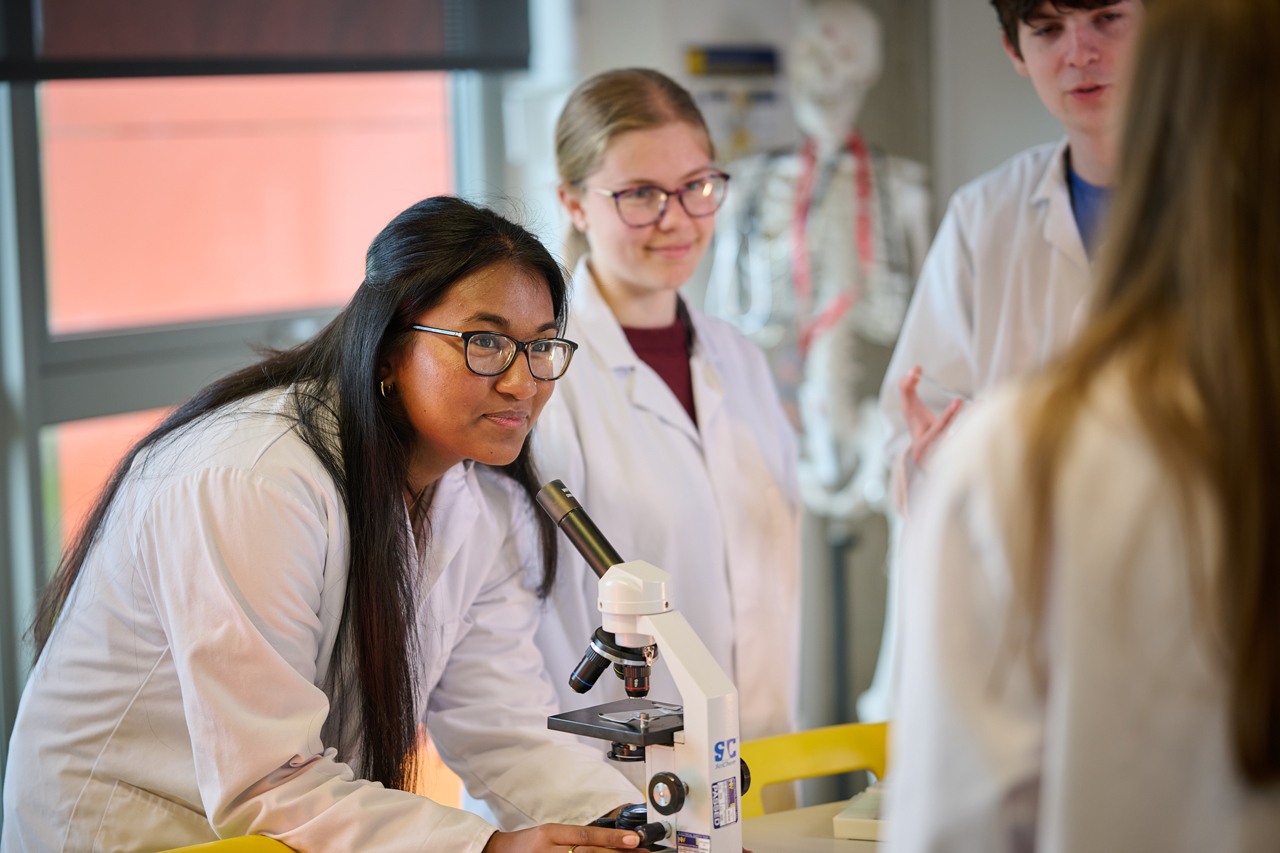
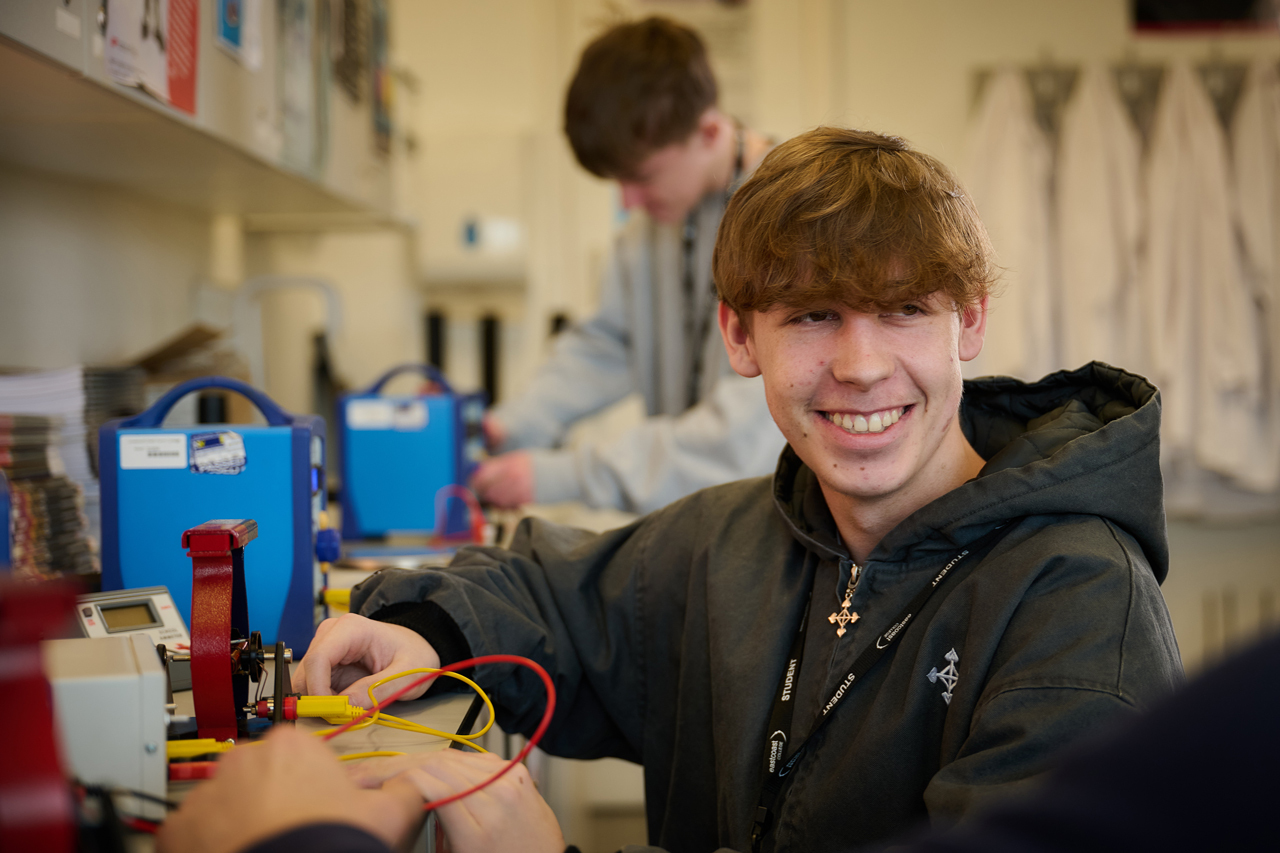
You will be working in modern laboratories with excellent facilities and equipment, including oscilloscopes and data logging equipment. There may be opportunities for trips to see physics in action within industry and the chance to experience lectures and/or hear from guest speakers. Classes are generally smaller and conducive to a more personal learning experience with more bespoke interactive one-to-one time between teachers and students.